
-
Featured University
-
Top 10 Universities
-
Profiles
-
Blog Archives

10 Excellent Sites to get Unbiased Online University Reviews
Choosing an online university is a hard decision, and getting harder because of the huge amount of targeted advertising and marketing campaigns that the largest and wealthiest schools use to get students’ attention. There are many organizations that claim to provide unbiased reviews of both online and campus universities, but even if the rating organizations seem legitimate, it can be hard to know how they arrive at their school rankings.
Different rankings may carry different weight for your personal situation as well. If you’re looking for an online college, it probably doesn’t matter much whether the school has a great athletic department. Rating agencies usually offer ratings for different general types of schools. Several useful metrics for determining the quality of a college are:
- Post-graduation Employment Levels: Colleges often keep track of their students after graduation, and publish a percentage of recent alumni who have attained a job in their field of study, or who are fully employed at all. While this number is no guarantee, a high post-graduate employment rate can point to a school’s relevancy in certain fields, or strong career services department for students.
- Graduation Rates: A school’s retention rate is important to them, and should be a factor for students considering going there. If 90% of a school’s first-year class makes it to graduation, that’s impressive, but if a large percentage of students that start taking classes never actually get a degree, it’s important to ask why. Rating agencies factor this data into some of their statistics.
- Grade Point Averages: Grade inflation and new research about how people learn have somewhat diminished the significance of a school’s average GPA, but a lot of people are still impressed at seeing a 4.0. A college whose students mostly have high GPAs gets some points for its academic rigor, though there are numerous ways to cook the numbers that are leading some critics to devalue this once paramount measure of worth. Getting good grades still matters, though, and college ratings agencies know it.
Ultimately, the factors that are important to you may not be the same factors that ratings agencies use to judge schools. Do careful research on the schools you apply to, and if you look at ratings, make sure you’re only using them to supplement other hard data you’ve found, and remember that your own needs are prime when choosing where to invest in your education.
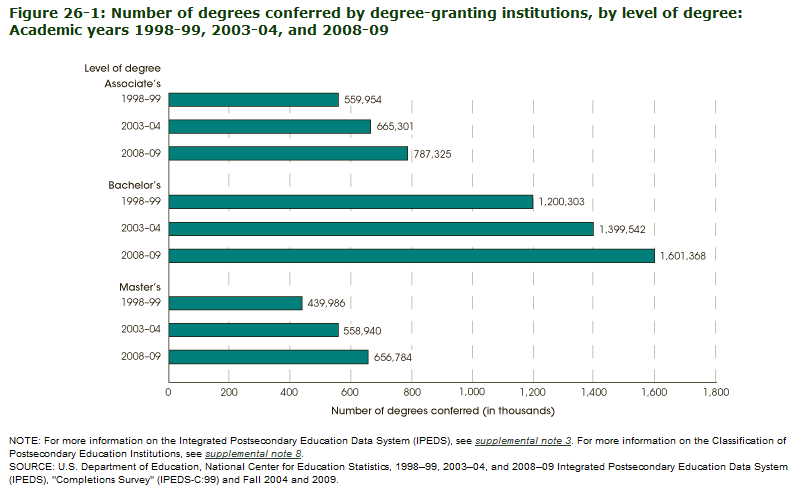
Another great place to look for hard data about general education trends and specific schools is the Department of Education’s National Center for Education Statistics. One trend that is meaningful for anyone looking at going back to school is the increase in degrees being issued over the past several decades. The graph below shows substantial, consistent increases in degree issuance. There are more degree holders now than ever before, and competition for jobs is stiff. Making sure you get the best education is crucial in the new knowledge economy.
College and University Rankings – Trusted Resources
- Forbes.com: Forbes is a leading source of reliable news that publishes an annual list of America’s best undergraduate institutions. America’s Best Colleges includes the complete list of all 650 schools. According to Forbes, the rankings are based on five categories: post-graduate success, which evaluates alumni pay and prominence, student satisfaction, which includes professor evaluations and freshman to sophomore year retention rates, debt, which penalizes schools for high student debt loads and default rates, four-year graduation rate, and competitive awards, which rewards schools whose students win prestigious scholarships and fellowships like the Rhodes, the Marshall and the Fulbright.
- US News and World Report: Although they recently went web-only, their rankings reports are still highly respected. Since 1983, U.S. News and World Report has been a leader in published its annual list: Best Colleges. Their rankings are based on the following criteria: peer assessment (25 percent), graduation and retention rates (25 percent), faculty resources (20 percent), student selectivity (15 percent), financial resources (10 percent), and alumni giving (5 percent).
- The Princeton Review: This well-regarded site has many different ranking lists from top party schools to most politically active student bodies. The Princeton Review divides the country into four regions and identifies 629 colleges that “stand out as academically excellent institutions of higher learning.” Their rankings rely on both student opinion and statistical data.
- College Prowler: While not as well-known as other sites, these rankings still provide an excellent view of universities. College Prowler hires student authors at campuses across the country to survey college students each month. College Prowler has grown rapidly since 2002 and now offers coverage of over 7,000 schools.
- The Times University Rankings: The Times Universities Ranking highlights the top 200 universities in the world. By partnering with rankings provider, Thomas Reuters, The Times Higher Education collects statistics based on the following criteria: academic peer review (40%), employer review (10%), staff/student ratio (20%), citations/staff (20%), international staff (5%), and international students (5%).
- Ruggs Recommendations:
 Ruggs Recommendations on the Colleges lists 14,000 academic departments at over 1,115 quality colleges. The book recommends undergraduate programs in the U.S. in the fields of liberal arts, agriculture, computer science, history, pre-law, sociology, zoology, and many more. Ruggs also covers 77 miscellaneous majors such as aviation management, exercise science, sports medicine, and other niche fields.
 - Academic Ranking of World Universities: Also known as the Shanghai ranking, this list ranks 1,200 schools globally and focuses more on natural sciences than the humanities. Its ranking methodology takes into account alumni achievement, including publication of research in high profile science journals and winning of Nobel prizes. It compares universities by looking at a per-capita-performance number for various achievements in the academic sphere.
- The Wall Street Journal: WSJ places heavy emphasis on employment, job-satisfaction and salary to rank U.S. colleges and universities. The journal arrives at its rankings by polling companies across the U.S. in a variety of industries about their highest performing employees, and which college they graduated from. Since many companies in the U.S. recruit employees directly from college campuses, the companies can provide highly performance-correlated data about which schools turn out the best graduates for a given profession.
- The Gourman Report: This ranking list is published by The Princeton Review, and credited to Dr. Jack Gourman. Because the methodology used to generate the rankings is not published, and new data has not been released since 1997, The Gourman Report should not be used as a sole source of college ranking data.
- Washington Monthly: WM is a political newsmagazine based in Washington, D.C., which offers news and opinion about the U.S. higher education scene as well as college rankings. According to their website, WM’s college rankings are based on three categories of factors: “Social Mobility (recruiting and graduating low-income students), Research (producing cutting-edge scholarship and PhDs), and Service (encouraging students to give something back to their country).” WM ranks colleges by category as well, and offers ranked lists of“liberal arts colleges” and “national universities,” among others.
Accreditation
In addition to reviews by the above listed publications, it is important to consider the accreditation status of any school you might attend. Any legitimate college needs to be evaluated for its efficacy and contribution to academia in its fields. There are several regional and national bodies that provide accreditation for postsecondary education institutions. The U.S. Department of Education (DOE) does not accredit schools, but does provide a list of accredited institutions, and approved accrediting bodies.
According to the DOE “[t]here are two basic types of educational accreditation, one identified as “institutional” and one referred to as “specialized” or “programmatic.” Institutional accreditation normally applies to an entire institution, indicating that each of an institution’s parts is contributing to the achievement of the institution’s objectives, although not necessarily all at the same level of quality. Specialized accreditation normally applies to the evaluation of programs, departments, or schools which usually are parts of a total collegiate or other postsecondary institution

The accrediting process includes a battery of quality assurance tests that are applied to any institution seeking accreditation. The school that wishes to be accredited must prove that its “mission documents are clear and articulate publicly the institution’s commitments.” This criterion is intentionally left vague because it is not the goal of the accrediting body to force all schools to fit a particular mold, but to assure high educational standards in diverse institutions. Other criteria for accreditation include:
- ”Understanding and support for [the institution’s] mission pervade the institution.”
- ”The institution assesses the usefulness of its curricula to students who will live and work in a global, diverse, and technological society.”
- ”The institution has the capacity and commitment to engage with its identified constituencies and communities.”
- ”Internal and external constituencies value the services the institution provides.”
The full list of accreditation requirements postulated by the Higher Learning Commission, one of the DOE approved regional accrediting bodies in the U.S., is available at their website. You should not attend a school that is not accredited by an approved accrediting body, as a degree from that school has a lot less credibility in both academia and the business world than a degree from an accredited institution.
/10-excellent-sites-to-get-unbiased-online-university-reviews