
-
Featured University
-
Top 10 Universities
-
Profiles
-
Blog Archives

What Are the Largest Online Universities in the US?
Online universities are gaining credibility in rankings and in the professional world as more people seek degrees for career enhancement. One way to ensure that you get a strong online education is to make sure a school is accredited. Another way to determine a school’s suitability for you is to learn more about class size. Small classes may be more personal, but a larger online university may have more diverse course offerings. Depending on your school’s reputation, name recognition can either help or harm the credibility of your online degree. The size of the university should only be one part of the calculation you use to decide which school is for you.
What Are Your Options?
The National Center for Education Statistics has a nifty College Navigator tool to help you learn more about online colleges, including their size, enrollment numbers, and graduation rates. A college’s reputation is also important, though actual statistics about that college’s academic rigor are more useful. Size is not the most important aspect of any university, but it is a factor to consider when deciding where to enroll.
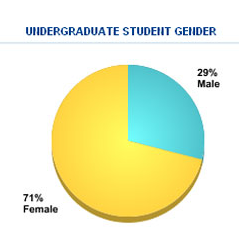
The University of Phoenix Online is a popular school with immediate name recognition. Below is a snapshot of their undergraduate enrollment’s gender composition. The student population of the school is listed at 54,371.
Customizing Your Experience
You can mix your online college experience with a traditional degree. Some colleges offer courses within their programs that you can take online. This offer can cut gas prices and commute time for students who want that cost-saving feature. Most online class instructors still expect students to purchase the textbooks and any supplies for that class, even if it is through distance education.
Other colleges will accept transferred online course credits if you take the courses at an accredited school and if those courses fit the program at a traditional college. Three fairly common non-traditional paths through higher education are:
- Taking general education requirements and exploring possible paths online, then finishing degree specific courses and practical experience or internships at a campus college.
- Finishing an associate’s degree in a specific subject online, then attending campus college to progress through a bachelor’s or even a master’s degree.
- Beginning your education at a campus college, and augmenting your schedule with online courses during summer so you can finish a degree more quickly.
Some subjects are not conducive to online learning. For instance, if you want to earn a Master of Fine Art (MFA) degree, you could take your general courses online, but you might want to take studio classes on campus under the watchful eye of an expert. Many online courses require some type of practical, clinical, or hands-on experience. This requirement may disrupt your ability to keep a job while taking classes, but it also offers you a chance to test out the new career you’re training for, and gain experience in a more lucrative field.
Who Are the Students at Online Universities?
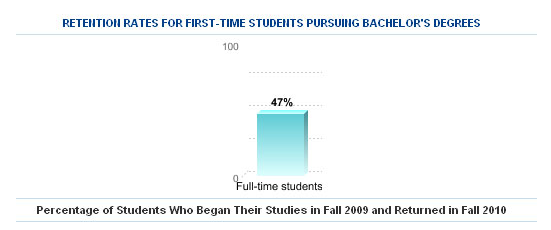
In 2011, the U.S. Department of Education’s National Center for Education Statistics (NCES) created an overview of undergraduate students who took online courses in 2007-2008. About 4.3 million undergraduate students, or 20% of all undergraduates, took at least one distance education course during that time. About 4% of all students used distance education for their entire degree. Below is a graph that illustrates the University of Phoenix’s retention rates, an indicator of how many students decide to transfer or postpone schooling after their first year.
The percentage of undergraduates who took any distance education courses rose from 16% in 2003–04 to 20% in 2007–08; over the same period, the percentage who took their entire program through distance education decreased from five to four percent. In addition to these undergraduate students, about 22% of all post-baccalaureate students took distance education courses in 2007–08.
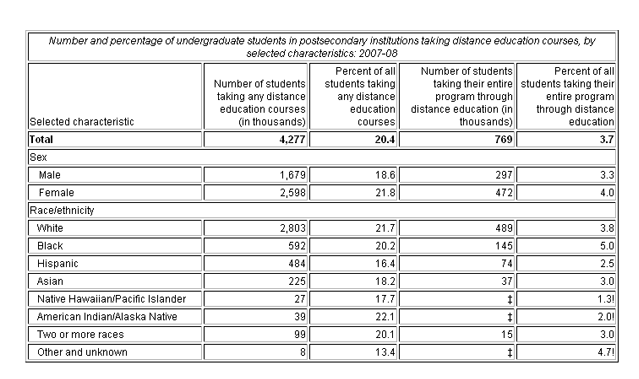
While online degrees decreased somewhat during those years, online participation rose to new heights. The growing recognition of online classes as legitimate contributes to this increase in participation.
One sign of the growing legitimacy of online education is that long-running traditional universities are starting to offer online versions of their programs. One example is Liberty University, a traditional campus located in Lynchburg, Virginia, which has grown to include an online enrollment of nearly 62,000 students. These online courses actually have helped to eliminate traffic jams in the area, and have contributed to easing this city’s worries about asking taxpayers to contribute money to build a larger infrastructure to handle additional traffic.
Outside relieving cities of undue traffic burdens, universities can add to their own growth through online courses. It is to their advantage to offer you the best classes and instructors at the same cost or better than it would cost on campus. If you want to study Christian theology courses, why visit Lynchburg when you can get those same courses online at home?
Liberty University’s August 2011 press release states that the online portion of the school reached 25,000 students in 2008 and has more than doubled that number in just two years. These online students, combined with the 12,370 who attend on-campus courses, place Liberty in the top spot as the largest Christian university in the world.
Why Get a Degree Online?
If you’re searching for information about online classes, then you’re probably aware that further education can help advance your career. You also might understand that a degree can help you earn more money over a lifetime. If you’re worried about the cost of education, the flexibility of online courses can provide you with time to work while you’re in school. Additionally, many online courses — especially those offered by traditional campuses in their degree programs — offer financial aid. Financial aid comes in many forms from both the government and from private sources, including:
- Low-interest Federal Stafford Loans and Perkins Loans
- Educational Tax Credits such as the HOPE and TEACH credits
- Institutional scholarships from your school of choice.
- Federal Pell Grants and other educational funds that do not need to be repaid

Many online colleges offer federal student loans, especially larger online universities. Earning a degree and putting off the loan payments until after graduation is an appealing opportunity that works for online as well as traditional degrees. You may also be able to defer a current school loan by enrolling in an online college. Earning an education now and resuming payments upon graduation may work for some individuals.
Online courses let you work from home, or wherever you have access to a computer with internet capabilities. This is a huge advantage if you don’t have reliable transportation or the money for transportation or dorms. Online classes eliminate travel time to and from the classroom, which means more time to complete homework assignments and to study. Plus, some classes may not be available at a local college, but could be available online.
But, online courses also have different challenges than traditional classes:
- Coordinating time to study or converse with classmates can be difficult online.
- Programs may seem unstructured, and it could become easy to forget about homework or to procrastinate until the last minute to finish your projects.
- When all class materials are delivered digitally, it can be hard to grasp concepts that would be taught “hands-on” in a typical classroom.
Consider a Variety of Factors When Choosing Your Program
Though online education has its own unique challenges, a student with the stamina to complete any program or degree — online or on campus — can overcome these issues. Almost any credential available at a brick-and-mortar school is also available electronically. Students can earn certifications, a bachelor’s degree, a master’s degree and even a PhD online.
It’s up to you to decide whether you want to attend a large, recognized online university or a smaller, less known college. As long as your program is accredited by an authorized agency, you can receive an education online that is as valuable as your campus experiences.
/what-are-the-largest-online-universities-in-the-us